ADRI is a new digital program that helps primary school children learn to read by combining playful activities with personalized support. In this project, the team co-designs the Italian materials together with teachers to create a validated and easy-to-use version for inclusive use in Ticino schools.
Extending Equity in Reading Acquisition through Adaptive Digital Reading Interventions
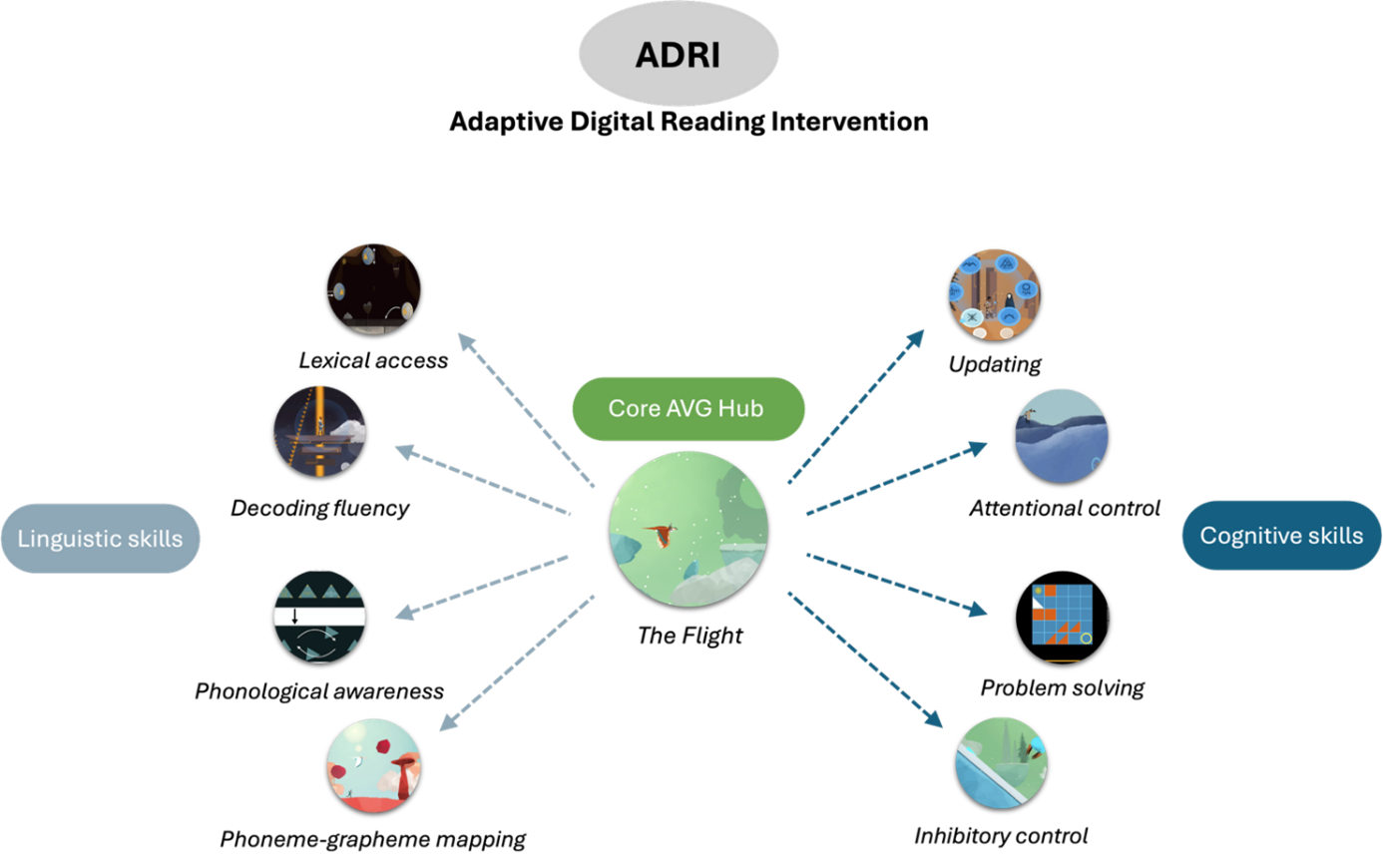
ADRI is an evidence-based digital program designed to support early reading development through a combination of linguistic training and cognitive strengthening. The activities within ADRI are delivered through the child-friendly game environment of Legend of Hoa’Manu (LoH). LoH provides the modular and adaptive structure that presents short, engaging learning activities to each child according to individual needs.
At present, ADRI is being developed in French within the NCCR Evolving Language. Teachers and students in the Italian-speaking region do not yet have access to comparable materials. This Associate Project responds to this gap by developing and co-designing the Italian component of ADRI. The goal is to produce high-quality materials that reflect the linguistic structure of Italian and the educational needs of primary schools in Canton Ticino.
Reading development depends on the interaction of several linguistic skills, such as phoneme to grapheme mapping and decoding, and key domain-general cognitive abilities including attention, working memory, and cognitive flexibility. ADRI integrates these elements into a unified, adaptive program that adjusts the type and difficulty of activities based on each child's learning profile.
Italian has a transparent orthography, and for this reason the linguistic materials cannot simply be translated from the French version. They require a dedicated design process that aligns with the structure of Italian, current curricular expectations, and developmental progressions in early literacy.
The present project thus focuses on the translational development of ADRI in Italian. The main activities include:
designing and adapting linguistic materials in collaboration with literacy experts and native-speaking teachers;
organizing co-design workshops to refine content, instructions, and classroom implementation;
conducting usability and playtesting sessions with primary-school children in Canton Ticino to ensure clarity, engagement, and age appropriateness;
integrating all materials into the LoH platform using ADRI's multidimensional dynamic difficulty adaptation system.
Teachers and schools in Ticino play a central role throughout the project. Their experience guides decisions on material design, usability, and classroom workflows. This collaboration ensures that ADRI remains feasible in daily school practice and inclusive for a wide range of learners, including children who experience reading difficulties or who have special educational needs.
The outcome of this project will be a scalable, and openly accessible Italian version of ADRI. Deliverables include the complete set of Italian linguistic training materials, teacher guides, classroom implementation resources. Schools and educators will benefit from a scientifically grounded and practical tool that supports individualized learning and advances equitable early literacy outcomes in the Italian-speaking region of Switzerland.

Prof. Dr. Angela Pasqualotto
SUPSI
Project Leader



Sara Giulivi
SUPSI
Scientific Collaborator